- Overview
- Quick answer
- Key points
- What the Malaysia e-Invoice timeline means for records
- What interim relaxation changes
- MyInvois field checks after 15 August
- Not the same as a PDF invoice
- Simple example
- Records to clean up for current MyInvois checks
- How accounting software fits the workflow
- A practical preparation workflow
- Frequently asked questions
- In short
Malaysia e-Invoice Records Small Businesses Need for MyInvois
Published July 4th, 2026 | Updated September 4th, 2026 | Team Gimbla
Malaysia e-Invoice is now an active bookkeeping and data-quality issue for businesses in the 2026 phases. Before an invoice reaches MyInvois, customer, supplier and transaction records need to satisfy the current validation rules as well as the business’s exemption or interim-relaxation position. The practical job is to review TIN and BRN data, valid dates, invoice numbers, payment terms and code fields, then keep the validated invoice and payment trail connected in the books.
HASiL’s current SDK lists Tax Identification Number (TIN) and Business Registration Number (BRN) validation from 1 August 2026 and additional Production field rules from 15 August 2026. It also schedules new amount and passport-field limits for 23 October 2026. That makes clean master data and a testable submission workflow more useful than another generic implementation countdown.
HASiL keeps the 2026 implementation dates in place, but its 30 August 2026 announcement raised the exemption threshold from RM1 million to RM3 million, effective 1 September 2026. Separate interim treatment remains available through 31 December 2027 for the up-to-RM5 million cohorts. That treatment is not an exemption: a business using it still follows a monthly consolidated submission process, while a ready business may issue individual documents instead.
Current MyInvois readiness joins three checks: tax scope, valid submission data and accounting evidence that connects each invoice to its payment.
Quick answer
Malaysia e-Invoice is the country’s staged move to structured transaction data and near real-time tax validation. HASiL’s e-Invoice Guideline v4.8 lists the headline phases and the current exemption rules. Taxpayers with annual turnover or revenue below RM3 million may qualify for an exemption, but they should not assume turnover alone settles the answer. Businesses already in scope should now review their MyInvois data against the live August validation rules rather than treating implementation as a future project.
HASiL’s General e-Invoice FAQs separate mandatory implementation from the treatment allowed during interim relaxation. The Q104 table lists the relaxation through 31 December 2027 for the up-to-RM5 million cohorts. Q106 and Q107 say a taxpayer that is not ready for individual documents may use the permitted consolidated treatment, but must still submit consolidated e-Invoices or consolidated self-billed e-Invoices monthly. A ready taxpayer may choose individual issuance instead.
The current guideline says the exemption does not apply when a taxpayer has a non-individual shareholder with annual turnover or revenue of at least RM3 million, is a subsidiary of a holding company at or above that amount, or has a related company or joint venture at or above that amount. A taxpayer below the headline exemption threshold can therefore still be in scope when one of those connected-entity tests applies.
For a small business, the safest first step is not choosing a technical integration. It is checking whether invoice records are complete enough for an accountant, tax agent or software adviser to review: customer details, supplier details, transaction descriptions, SST treatment where relevant, credit notes, payment records and reconciliation.
Key points
- Separate three questions: the mandatory date, exemption status and whether individual or interim monthly consolidated treatment applies.
- Check TIN, BRN, dates, field lengths and code values against the current MyInvois SDK before submitting.
- Keep customer, supplier, invoice and payment records in one reliable workflow.
- Do not treat Malaysia e-Invoice as the same thing as emailing a PDF invoice.
- Prepare now for the next scheduled amount and passport-field limits in October.
- Ask an adviser how consolidated e-Invoices, self-billed transactions, SST and unusual sales apply to your facts.
What the Malaysia e-Invoice timeline means for records
HASiL describes e-Invoice as a phased initiative to improve the efficiency of tax administration. The programme supports near real-time validation and storage of B2B, B2C and B2G transaction data.
The timeline is based on annual turnover or revenue. That makes record quality important because the business needs to know both when it may be in scope and whether its invoice data can support the workflow.
| Business position | Official timing to check | Current bookkeeping and system check |
|---|---|---|
| Annual turnover or revenue above RM100 million | Mandatory phase started 1 August 2024 | Review live e-Invoice controls, corrections and reconciliation |
| Above RM25 million and up to RM100 million | Mandatory phase started 1 January 2025 | Check whether invoices, credit notes and payment records remain matched |
| Above RM5 million and up to RM25 million | Mandatory phase started 1 July 2025 | Confirm customer, supplier and tax details are held in software records |
| Up to RM5 million | The main phase started 1 January 2026; qualifying taxpayers below RM3 million are exempt | Choose individual issuance if ready, or prepare monthly consolidated submissions under the relaxation rules |
| Below RM3 million | Exemption may apply, but it is not automatic | Check ownership, holding-company, subsidiary, related-company and joint-venture criteria with an adviser |
This is a practical summary of the official timing, not tax advice. Check HASiL’s current guidance and your adviser before relying on a threshold, exemption or transaction treatment. A business below RM3 million that fails an exemption criterion may already be in scope, so do not use the threshold as a stand-alone decision rule.
What interim relaxation changes
The implementation date, exemption test and interim treatment answer different questions. The implementation date decides when a taxpayer enters the e-Invoice framework. An exemption can remove the obligation for an eligible taxpayer. Interim relaxation instead changes how an in-scope taxpayer may handle documents while its transaction-level process is not ready.
HASiL’s current FAQ sets out two practical paths for affected smaller taxpayers:
- A taxpayer that is ready may issue individual e-Invoices and individual self-billed e-Invoices under the normal rules.
- A taxpayer using the interim treatment may consolidate the allowed e-Invoice and self-billed records, but still needs to submit those documents every month rather than waiting until the relaxation ends.
That choice needs to be checked against the business’s transaction types and the current Specific Guideline. It should not be confused with the separate below-RM3 million exemption criteria.
MyInvois field checks after 15 August
HASiL’s MyInvois SDK release notes say TIN and BRN validation for the Validate Taxpayer’s TIN API started on 1 August 2026. The same page lists ten field-validation rules for the Production environment from 15 August 2026, following Sandbox testing.
The practical checks include:
- dates must use
YYYY-MM-DD; placeholders such asN/Aare not valid dates - an e-Invoice code or number has a 50-character maximum, while bank account and prepayment-reference fields have their own stated limits
- Incoterms, units of measurement, state, country, payment, tax and currency fields need the permitted codes
- business activity descriptions and payment terms need to stay within the listed character limits
- TIN and BRN details should match the records used by HASiL’s validation service
HASiL’s current release-note page does not show a separate dated notice confirming the Production deployment after 15 August. Integration owners should therefore use the live SDK as the source of truth, test representative documents and investigate validation failures rather than assuming every existing payload still passes.
The next scheduled change is 23 October 2026, when the SDK says monetary amount fields will have a 26-digit maximum and the PASSPORT identifier will have a 12-character limit. Most small-business amounts will not approach that ceiling, but software providers and businesses with imported or unusual data should test before the change.
Not the same as a PDF invoice
Emailing a PDF invoice may be electronic, but it is not the same as an e-Invoice workflow. Malaysia’s model is about structured transaction data and validation in a tax-administration context.
That distinction matters because PDF habits can hide weak records:
- customer names stored differently across invoices, emails and payment records
- supplier details saved in a spreadsheet instead of the accounting file
- invoice numbers reused, skipped or manually changed
- payment references that do not match the invoice or receipt trail
- credit notes disconnected from the original sale
- SST details reviewed only at reporting time
For the broader concept, see the eInvoicing glossary. If you need the underlying document first, start with invoice and tax invoice.
Simple example
Imagine a Kuala Lumpur cafe that entered one of the 2026 phases. It sells to walk-in customers, caters office events and buys supplies from several local vendors.
Before sending its next e-Invoice, the owner and bookkeeper should check four parts of the record:
- Customer TIN and registration details match the master data used for validation.
- The issue date, invoice number, payment terms and required codes fit the current SDK rules.
- Supplier bills, credit notes and payments are saved against the right contacts.
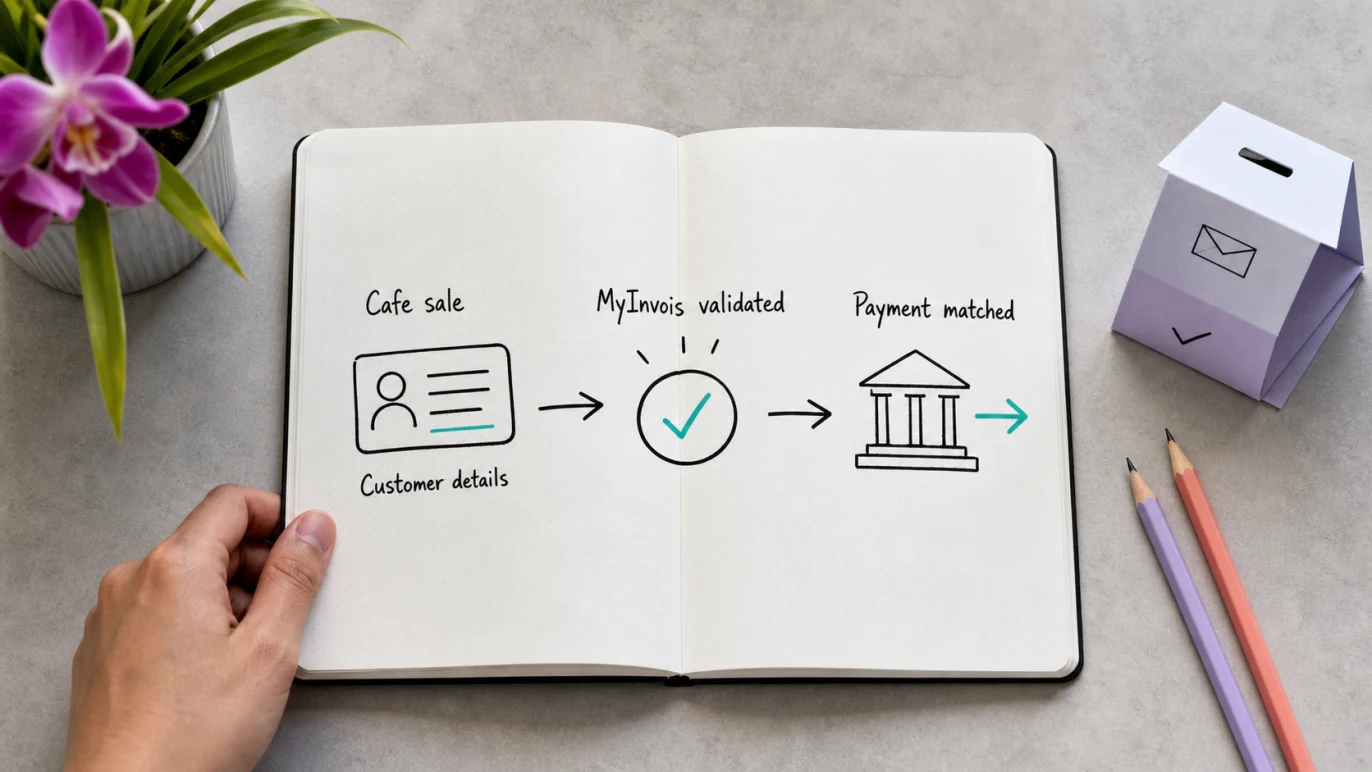
- The validated invoice, status and bank payment can be followed as one evidence trail.
If the cafe is in scope but not ready for individual e-Invoices, interim treatment may allow consolidated e-Invoices. That still means following the monthly submission schedule, not waiting until the relaxation ends. If its process is ready, the cafe may use individual e-Invoices instead.
The e-Invoice workflow may be handled through MyInvois, software or adviser-supported processes. The bookkeeping file still needs a clean trail from sale to validation to payment matching.
Records to clean up for current MyInvois checks
Start with the records that usually cause rework during invoice review.
Customer and supplier details
Keep names, addresses, contact details, tax identifiers where relevant, business registration details where advised, and payment terms in a consistent place. Test TIN and BRN details rather than copying unverified values from an old invoice or email thread.
Invoice and credit note numbering
Review invoice sequences, cancelled invoices, credit notes and adjustment notes. Keep e-Invoice numbers within the current field limit, and make any change easy to explain from the accounting record.
Transaction descriptions
Use descriptions that a customer, accountant or tax agent can understand without opening a separate spreadsheet. Avoid vague line items that make the supply hard to classify later.
Payment trail
Match bank deposits, bank transfers, card settlements and cash records to the right customer invoices or supplier bills. A strong bank reconciliation habit makes the e-Invoice record easier to trust.
Adviser notes
Keep notes for unusual transactions, mixed supplies, deposits, refunds, self-billed arrangements or cross-border work. Those details can change the practical treatment, so they should not sit only in someone’s memory.
How accounting software fits the workflow
Accounting software is not a substitute for HASiL guidance, tax advice or a compliant e-Invoice submission process. Its role is to make the underlying records cleaner.
In Gimbla, Malaysian small businesses can keep core bookkeeping records together:
- create sales invoices with consistent customer and line-item details
- record supplier bills and credit notes
- match payments during bank reconciliation
- keep tax-related records connected to invoices and reports
- give an accountant a clearer review trail
The Malaysia accounting software page explains the local bookkeeping workflow for invoices, expenses, cash flow and ringgit records. For tax setup concepts across markets, see the GST, VAT and sales tax guide.
A practical preparation workflow
Use this as a current record-and-validation review with your adviser or software provider.
- Confirm the business’s annual turnover or revenue band, ownership structure and any related-company or joint-venture position.
- Decide with your adviser whether the business is exempt, ready for individual e-Invoices or using interim consolidated treatment with monthly submissions.
- Validate customer and supplier TIN and BRN details using the current approved process.
- Test representative sales, self-billed documents, credit notes and refunds against the live date, length and code rules.
- Review invoice numbering, cancelled invoices and adjustment records.
- Match recent bank deposits and payments to the right invoices and bills.
- Check imported and unusual data ahead of the scheduled October field limits.
- Keep validation statuses, errors, corrections and submission confirmations with the accounting evidence.
Frequently asked questions
Does Malaysia e-Invoice affect every small business in 2026?
Not every business has the same timing. Taxpayers with annual turnover or revenue below RM3 million may qualify for an exemption, but it is not automatic. Ownership, holding-company, subsidiary, related-company and joint-venture tests can remove the exemption, so check the detailed HASiL criteria and your own structure before relying on the threshold.
Is Malaysia e-Invoice the same as emailing a PDF invoice?
No. Malaysia e-Invoice is about structured transaction data and validation through the Malaysian tax-administration framework, not simply sending a PDF by email.
What should a business check after the 15 August validation change?
Review MyInvois data for valid dates, permitted codes and the current field-length limits, then test the submission process and keep validation evidence. Customer and supplier TIN and BRN records are also worth checking before the next submission.
Does interim relaxation mean Malaysia e-Invoice is optional?
No. Interim relaxation changes the permitted treatment for in-scope taxpayers; it is not an exemption. Taxpayers using it still submit consolidated e-Invoices or consolidated self-billed e-Invoices monthly. A taxpayer whose system is ready may issue individual documents instead.
In short
Malaysia e-Invoice readiness is now a record-quality and validation job, not a future software countdown. Know the business’s scope, test current MyInvois data, keep invoice and payment evidence connected, and prepare for the next scheduled field limits.