- Overview
- Key Points
- MYOB Pricing Snapshot for 2026
- Gimbla Pricing Snapshot
- MYOB vs Gimbla: Practical Cost Comparison
- What the MYOB Base Price Does Not Show
- Feature Areas to Compare Before Switching
- When Gimbla May Be the Better Fit
- Switching Checklist from MYOB to Gimbla
- Frequently Asked Questions
- Conclusion
MYOB Pricing 2026: Compare Business Plans With Gimbla
Published May 20th, 2026 | Updated August 5th, 2026 | Team Gimbla
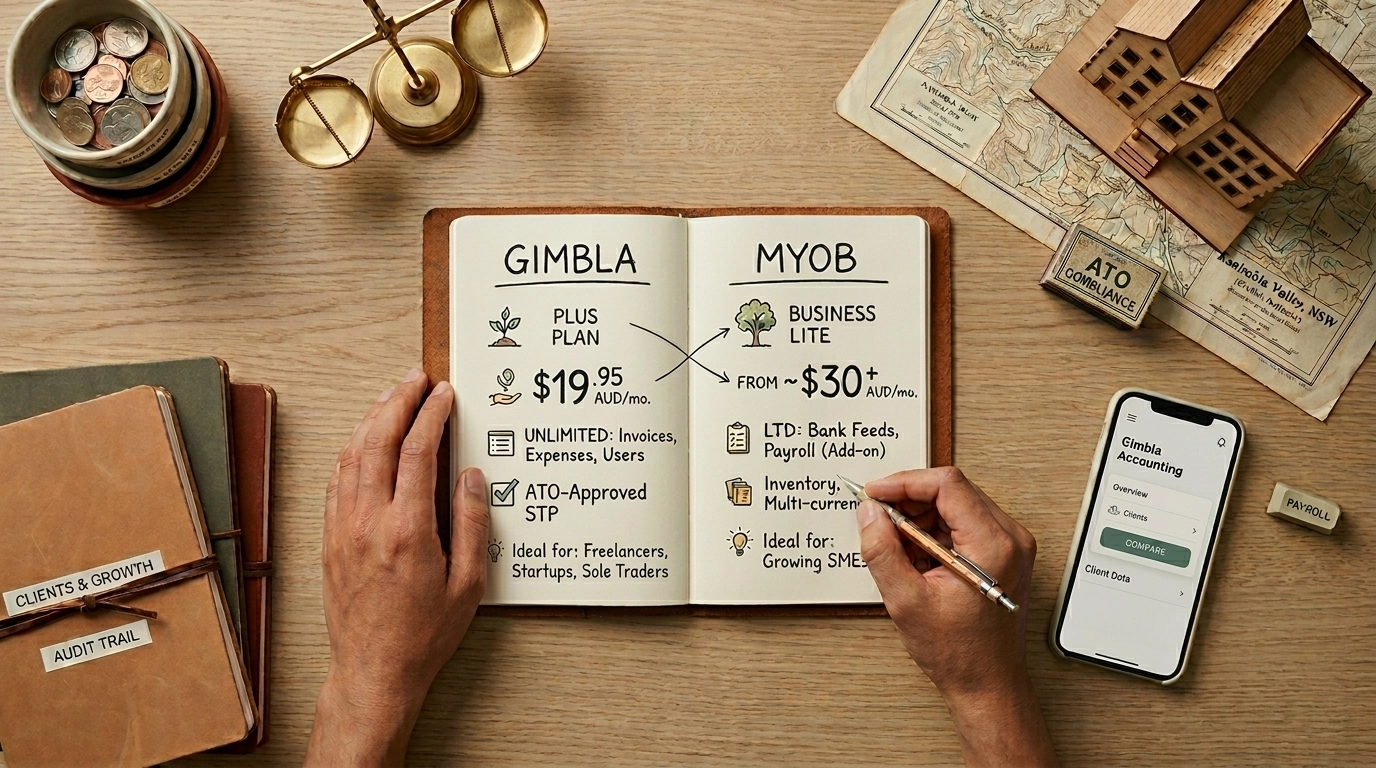
MYOB remains a familiar accounting name for Australian businesses, but the plan that fits your business is not always the cheapest headline offer. In 2026, the practical comparison is between your real workflow, your ongoing cost after discounts, and the features you actually need: invoices, expenses, GST, BAS, bank feeds, payroll, inventory, reports, user access and switching support.
This guide compares MYOB Business pricing with Gimbla so sole traders, employers and small teams can make a cleaner software decision before their next renewal or plan upgrade.
Quick answer: MYOB’s current Australian pricing page lists regular prices after offers from $99 per year for Solo and $315 per year for Lite to $210 per month for AccountRight Premier. Its terms say GST is added unless a fee is stated as GST inclusive, and payroll or other premium features can add to the base subscription. Gimbla has a free Starter plan and a Plus plan listed at $19.95 per month. Compare the final bill and workflow fit, not the headline discount alone.
Key Points
- Compare the regular price after an introductory offer, then confirm whether GST is already included in the displayed amount.
- MYOB Business Lite and Pro list payroll as an extra $3 per month per employee, while AccountRight Plus and Premier include unlimited payroll.
- Premium inventory, online payments and AI BAS can add fees or different subscription commitments to the base plan.
- Gimbla’s free accounting software covers core records, while Plus adds Australian BAS, payroll, bank-feed, project and multi-currency workflows.
- If you are switching, plan the cutover around bank reconciliation, GST/BAS periods, open invoices, unpaid bills and payroll year-to-date figures.
MYOB Pricing Snapshot for 2026
MYOB’s Australian pricing page, checked on 5 August 2026, lists regular prices and temporary introductory offers. MYOB’s Business terms say GST is added when a fee is not stated as GST inclusive. The GST-inclusive figures below apply that rule to the advertised regular prices.
| MYOB plan | Displayed regular price | Approx. price with 10% GST | Introductory price shown on 5 August 2026 | Useful context to check |
|---|---|---|---|---|
| Solo | $99/year | $108.90/year | $12/year for the first 12 months | Mobile-first sole-operator app; no payroll |
| Business Lite | $315/year | $346.50/year | $94.50/year for the first year | Up to 2 payroll employees; payroll is extra |
| Business Pro | $70/month | $77.00/month | $21/month for the first 6 months | Unlimited payroll employees; payroll is extra per person |
| AccountRight Plus | $165/month | $181.50/month | $66/month for the first 3 months | Unlimited inventory and payroll |
| AccountRight Premier | $210/month | $231.00/month | $84/month for the first 3 months | Multi-currency, advanced inventory and a second business |
| Payroll Only | $15/month | $16.50/month | $2/month for the first 3 months | Standalone payroll for up to 4 employees |
Introductory offers have eligibility rules and can change. Use them to estimate the first bill, then use the regular GST-inclusive price and any add-ons for the ongoing budget.
Gimbla Pricing Snapshot
Gimbla keeps the pricing structure simpler. The pricing page lists:
| Gimbla plan | Monthly price | Often suits |
|---|---|---|
| Starter | $0.00 | Businesses that need invoices, bills, payments, receipts, users, double-entry bookkeeping, reconciliation, tax tracking, reports and daily backups |
| Plus | $19.95 | Businesses that need the Starter features plus attachments, multi-currency, recurring documents, imports, projects, email support, and Australian BAS/payroll workflows where available |
For Australian businesses, Plus also supports payroll and STP reporting for up to 4 employees, with additional employee pricing described on the pricing page. It also supports connected bank accounts where bank feeds are available.
MYOB vs Gimbla: Practical Cost Comparison
The table below is not a feature-for-feature replacement claim. It is a starting point for understanding ongoing subscription cost before you compare workflow depth.
| Scenario | MYOB listed ongoing price | Gimbla comparison point | Base annual difference |
|---|---|---|---|
| Lite without payroll add-ons | $315/year | Gimbla Plus at $239.40/year | $75.60 |
| Lite with 2 payroll employees | $387/year | Gimbla Plus at $239.40/year | $147.60 |
| Pro before payroll add-ons | $840/year | Gimbla Plus at $239.40/year | $600.60 |
| Pro with 4 payroll employees | $984/year | Gimbla Plus at $239.40/year | $744.60 |
| AccountRight Plus | $1,980/year | Gimbla Plus at $239.40/year | $1,740.60 |
| AccountRight Premier | $2,520/year | Gimbla Plus at $239.40/year | $2,280.60 |
These are differences between the displayed base prices before GST treatment and extra charges, not a quote for either product. The saving is only useful if the workflow still fits. A product-heavy business may value MYOB’s inventory options. A small employer that mainly needs invoices, bills, GST, BAS, payroll, bank reconciliation and reports may not need a heavier plan.
What the MYOB Base Price Does Not Show
The base subscription is only one part of the cost review. MYOB’s current pricing, premium-features guidance and terms identify charges or separate conditions that can include:
- payroll usage on Lite and Pro, charged for each employee paid during the month
- premium inventory on lower plans
- transaction fees for online invoice payments
- AI BAS as a separate 12-month subscription commitment
The current plan table also labels AI BAS, AI Business Insights and Smart Reconciliation as beta features. If one of those features matters to your decision, confirm its plan availability, fee and current beta status rather than assuming it is included permanently in every subscription.
Feature Areas to Compare Before Switching
GST, BAS and Tax Records
Australian businesses should start with records. If you collect GST, the software needs to help you categorise transactions, keep tax invoices, review GST amounts and prepare Business Activity Statement (BAS) records.
Gimbla supports GST, VAT or sales tax tracking in the Starter plan, with BAS lodgment available on Plus for Australian businesses. If you are still learning the language, the GST glossary explains how GST appears in invoices, bills and reports.
Payroll and STP
Payroll is where the lowest accounting plan can become more expensive. MYOB Lite and Pro list payroll as an extra per employee, while AccountRight Plus and Premier include unlimited payroll. Gimbla Plus includes payroll processing and Single Touch Payroll (STP) for up to 4 employees, with extra employee charges described in the pricing notes.
If your business is preparing for Payday Super, compare more than the payroll button. Check employee records, pay runs, payslips, super, STP reporting and how payroll connects back to accounting reports.
Bank Feeds and Reconciliation
Bank reconciliation is where time savings usually show up. Compare how each system imports or feeds bank transactions, matches payments, handles exceptions and keeps an audit trail.
Gimbla supports bank reconciliation and bank feeds where available. If you are switching, reconcile your old MYOB file to a clean cut-off date before importing or reconnecting bank data.
Inventory, Jobs and Projects
MYOB may be the better fit if inventory, sales orders, stocktake or AccountRight workflows are central to the business. Do not move away from a system that is doing important operational work unless the replacement workflow is clear.
If your needs are more about job profitability, project income and simple cost tracking, compare Gimbla’s projects feature and the broader guide to accounting packages available in Australia.
Multi-Currency and Growth Features
MYOB’s plan table lists multi-currency on Premier. Gimbla Plus includes multi-currency accounting, which can matter if you invoice overseas customers, pay foreign suppliers or hold foreign-currency balances.
The broader 2026 accounting-software hub compares the main options used in Australia, including MYOB, Xero, QuickBooks, Reckon, Sage, FreshBooks, Zoho Books and Gimbla.
When Gimbla May Be the Better Fit
Gimbla is worth shortlisting when your business wants a lower-cost accounting workflow without giving up the basics that keep records useful.
It may suit you if:
- you want to start with a genuinely free accounting plan
- you issue invoices and bills but do not need a heavy inventory system
- you want unlimited users without paying for another seat
- you need GST, reports, reconciliation and room to add BAS or payroll workflows later
- you want a simpler plan structure before committing to a larger subscription
It may not be the right move if your business relies heavily on MYOB-specific inventory, sales order, AccountRight desktop, adviser or migration workflows. In that case, treat price as a reason to review your setup, not as an automatic reason to switch.
Switching Checklist from MYOB to Gimbla
Before moving accounting systems, create a clean handover point.
- Reconcile all bank accounts in MYOB to a clear cut-off date.
- Export contacts, items, chart of accounts, open invoices, unpaid bills and key reports.
- Save the Profit and Loss, balance sheet, GST/BAS summary, aged receivables, aged payables and payroll reports.
- Decide whether you are importing historical transactions or keeping past years as archived reports.
- Bring opening balances into the new system and compare the first reports.
- Reconnect bank feeds or import bank statements from the cut-off date.
- Rebuild payroll carefully, including employee details, leave, super and STP settings.
- Ask your accountant, bookkeeper or BAS agent to review the first reporting period.
The switching to Gimbla guide covers the practical setup path if you decide Gimbla is the right fit.
Frequently Asked Questions
How Much Does MYOB Business Cost in Australia in 2026?
MYOB’s pricing page lists Solo at $99 per year, Business Lite at $315 per year, Business Pro at $70 per month, AccountRight Plus at $165 per month, AccountRight Premier at $210 per month and Payroll Only at $15 per month after offer periods. MYOB’s terms say GST is added unless a price is stated as GST inclusive, and payroll is listed separately on Lite and Pro. Check the live pricing page before deciding because offers and feature charges can change.
How Does Gimbla Plus Compare With MYOB Business Pro on Price?
Gimbla Plus is listed at $19.95 per month, or $239.40 per year. MYOB Business Pro is listed at $70 per month after the offer period, or $840 per year. That makes the displayed base-price difference $600.60 per year before confirming GST treatment, payroll and other add-ons, or comparing workflow fit.
Should I Switch From MYOB Only Because of Price?
No. Price should trigger a review, but switching should depend on the work your software performs. Compare GST, BAS, payroll, bank feeds, inventory, reporting, accountant access, data export and the time needed to move cleanly.
Can I Move From MYOB to Gimbla During the Financial Year?
Yes, but choose the timing carefully. A month-end, quarter-end or financial year-end cutover is usually easier to review. If payroll or BAS reporting is active, ask your accountant, bookkeeper or BAS agent to check the transition.
Conclusion
MYOB can still be a strong fit for businesses that value its product family, inventory options or existing adviser workflow. But if you are mainly paying for invoices, bills, GST, bank reconciliation, reports and a small Australian payroll workflow, it is worth comparing the ongoing cost with Gimbla.
Start with Gimbla pricing, then read the MYOB Business vs Xero comparison and the 2026 Australian accounting software guide to decide whether your current plan still matches the way your business works.