- Overview
- Quick answer
- Key points
- Details required on every payslip
- Extra details required when they apply
- A payslip, section by section
- Helpful fields that are not always mandatory
- What must not appear on a payslip
- When and how to give a payslip
- Payslip review before sending
- Payslips and Single Touch Payroll are different
- How Gimbla helps
- Frequently asked questions
- The bottom line
What an Australian Payslip Must Include
Published July 11th, 2026 | Team Gimbla

An Australian payslip should let an employee answer three questions quickly: who paid me, what was I paid for, and how did gross pay become net pay? It also needs enough detail for the employer to support payroll records later.
The legal minimum is more specific than a single take-home-pay number. Employer and employee details, the pay period, payment date, earnings, deductions, super and applicable pay rates all have a place. Some familiar fields, including leave balances, year-to-date totals and bank-payment details, can be useful without being universal payslip requirements.
A good payslip is both compliant and easy to read: the employee should not have to reverse-engineer their hours, rates, deductions, super or take-home pay.
Quick answer
The Fair Work Ombudsman’s record-keeping and pay slips guidance says a payslip must show the employer’s name and ABN if any, the employee’s name, payment date, pay period, gross and net pay, and separately identifiable payments such as loadings, allowances, bonuses, incentives and penalty rates.
Where relevant, it must also show the employee’s hourly or annual pay rate, hours and amounts at an hourly rate, deductions and their destination, and super contribution and fund details. Give the payslip within one working day of pay day, even when the employee is on leave.
Do not identify paid family and domestic violence leave or its balance on the payslip. Check the employee’s award or enterprise agreement as well, because it may require information beyond the general rules.
This guide was checked against Fair Work’s pay slip template updated in July 2026. If an award, agreement, deduction or unusual pay arrangement is unclear, confirm the position with Fair Work or a workplace relations professional before running payroll.
Key points
- Issue every employee’s payslip within one working day of pay day.
- Show the pay period and payment date; they are not the same thing.
- Separate ordinary pay from loadings, allowances, bonuses, penalties and other identifiable entitlements.
- Show deductions clearly and include the relevant fund or account details.
- Show required super contribution and fund information where applicable.
- Treat leave balances, employee numbers, year-to-date totals and payment references as helpful fields unless another rule makes them necessary.
- Never identify paid family and domestic violence leave on a payslip.
Details required on every payslip
Start with the fields that apply to every employee payslip under the general Fair Work rules.
| Required detail | What it should show | Practical check |
|---|---|---|
| Employer | The employer’s name and Australian Business Number, if the employer has one. | Use the employing entity, not only a shop name or trading name. |
| Employee | The employee’s name. | Check it against the employee record, especially after a name change. |
| Payment date | The date the employee is paid. | Make sure it agrees with the approved pay run and payment record. |
| Pay period | The start and end dates covered by the pay. | Do not use only the processing date or payslip creation date. |
| Gross and net pay | Pay before deductions and the employee’s take-home pay after deductions. | Make the two totals prominent and easy to distinguish. |
| Separate pay items | Any loadings, allowances, bonuses, incentive payments, penalty rates or other separately identifiable entitlements paid. | Do not bury different entitlements inside one unexplained wages total. |
The payslip is evidence of one pay period. It does not replace the underlying employee, timesheet, leave, deduction, super or payment records that support the numbers.
Extra details required when they apply
The next fields depend on how the employee is paid and what happened during the pay period.
| Situation | What the payslip needs | Why it matters |
|---|---|---|
| Employee paid hourly | The ordinary hourly rate, number of hours worked at that rate and total amount paid at that rate. | The employee can compare approved hours, rate and earnings. |
| Employee paid an annual salary | The annual rate of pay that applies on the last day of the pay period. | The payslip records the salary rate used for that period. |
| Deductions made | Each deduction amount and the name, or name and number, of the fund or account receiving it. | The employee can see where amounts withheld from gross pay are going. |
| Employer must make super contributions | The amount of each contribution made or intended for the pay period and the super fund name, or name and number. | Super stays visible as a separate employer contribution rather than disappearing inside net pay. |
If several hourly rates apply, keep the ordinary, overtime, weekend or other applicable components clear. A casual loading can be separately listed or the payslip can explain that the hourly rate includes the relevant casual loading.
Only make deductions that are allowed. Fair Work’s deducting pay guidance explains the limited situations in which an employer may deduct money, including some written employee authorisations and deductions allowed by law, an order, an award or a registered agreement.
A payslip, section by section
The numbered sample below keeps the payslip in its normal layout. Match markers 1 to 6 with the explanations directly underneath. Its employee and business details are fictional, and the image is an example rather than a substitute for checking the current rules or an applicable award.
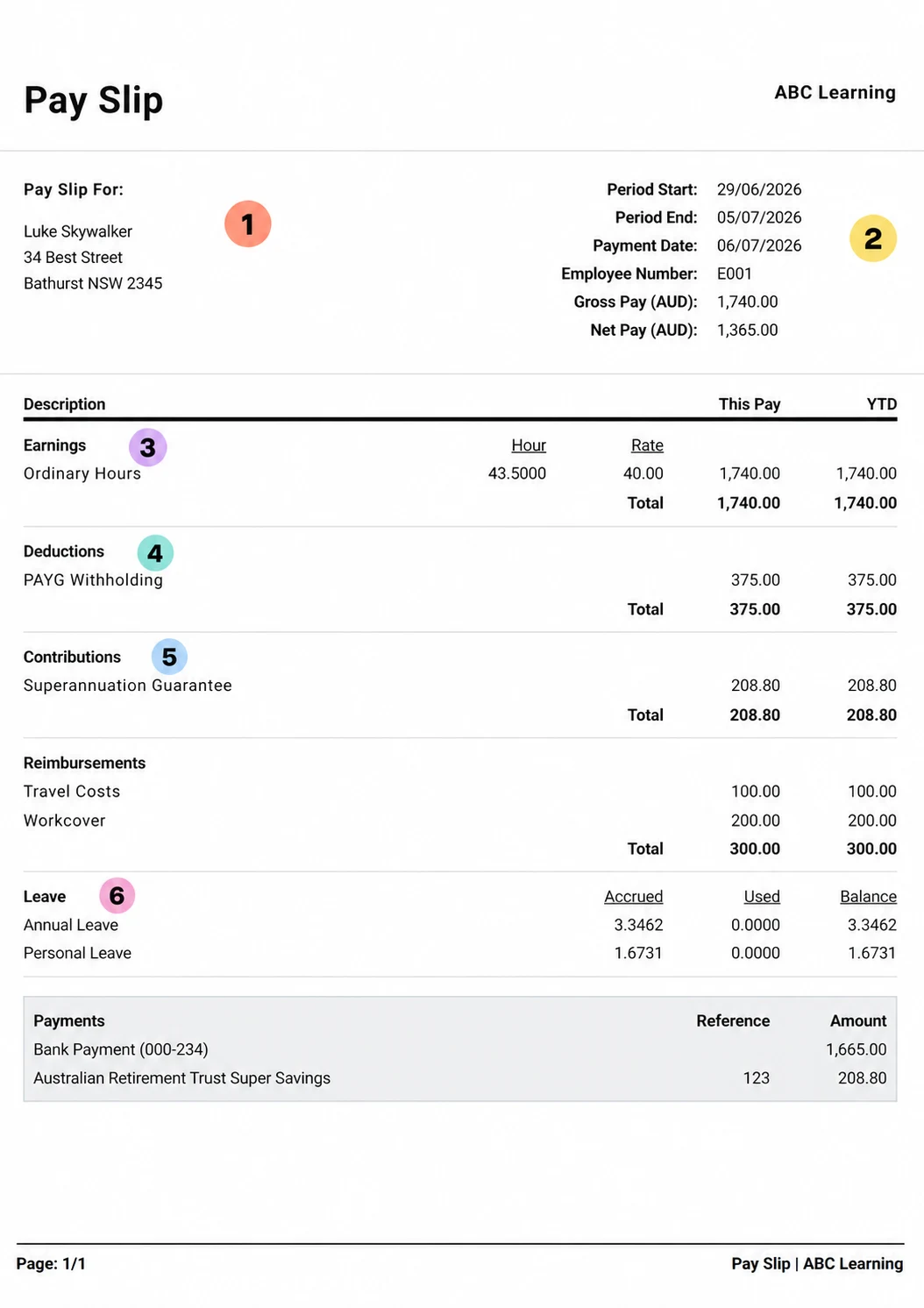
1. Employee and employer details
The employee’s name and employer’s legal name belong near the top. The employer’s ABN must also be included if it has one. An address, employee number, employment status, award and classification can help identify the record, but they are not substitutes for the required names and ABN.
The sample includes an employee address and number for clarity. If you include extra personal information, keep the payslip secure and disclose only what the employee needs.
2. Pay period, payment date and headline totals
The pay period explains when the work or salary relates to. The payment date records when the money is paid. A weekly pay period might end on Sunday while payment happens on Wednesday, so both are necessary.
Gross pay is the employee’s earnings before deductions. Net pay is the amount left after tax withholding and other lawful deductions. If reimbursements are paid in the same bank transfer, label them separately so the employee can understand why the cash movement may differ from net wages alone.
3. Earnings and entitlements
For an hourly employee, show the ordinary rate, hours and total paid at that rate. Separately show relevant overtime, penalties, allowances, loadings, bonuses, commissions, incentives and paid leave. Clear descriptions matter more than squeezing every item into one line.
For a salaried employee, show the applicable annual rate of pay. The employer still needs supporting records for hours, overtime or annualised wage arrangements where the law, award or agreement requires them.
4. PAYG withholding and other deductions
PAYG withholding is normally the largest deduction visible on an Australian payslip. Other deductions should be itemised rather than grouped into an unexplained total, with the destination fund or account identified as required.
The payslip describes what was deducted; it does not make an otherwise unlawful deduction valid. Keep the employee’s written authorisation or other legal basis with the payroll records where required.
5. Super and reimbursements
Employer super is separate from the employee’s net wages. Show the contribution amount for the pay period and the relevant fund details where the employer is required to contribute. The Superannuation Guarantee guide explains how employer super relates to payroll without treating it as an ordinary deduction from take-home pay.
Reimbursements can sit in their own section so a repayment of an employee expense is not confused with wages, an allowance or super. Use a description that lets the employee and bookkeeper trace the payment back to its supporting claim.
6. Leave and payment details
Annual and personal leave balances are useful because they help employees spot questions early. They are not a universal item on the Fair Work list of mandatory payslip fields, although an award, enterprise agreement or workplace arrangement may require additional information.
Year-to-date totals, payment method, a masked bank reference and payroll reference can also improve readability. Treat these as supporting details and never let them crowd out the required pay-period amounts.
Helpful fields that are not always mandatory
The Fair Work template marks some information as optional but encouraged. Use extra fields when they make the payslip easier to understand or another workplace rule requires them.
| Helpful field | How it helps | Important limit |
|---|---|---|
| Employment status | Shows whether the employee is full-time, part-time or casual. | It must agree with the real employment arrangement. |
| Award, agreement and classification | Makes later rate and entitlement checks easier. | Adding a label does not prove the classification is correct. |
| Leave balances | Helps employees monitor annual and personal leave. | Do not identify paid family and domestic violence leave or its balance. |
| Year-to-date totals | Shows cumulative earnings, deductions and contributions. | Keep current-period and year-to-date columns clearly separated. |
| Employee or payroll number | Helps match the payslip to the payroll record. | The employee’s name is still required. |
| Payment details | Helps reconcile the approved pay run to the payment. | Protect bank information and avoid unnecessary exposure. |
What must not appear on a payslip
Do not mention paid family and domestic violence leave, including a leave balance or a description that reveals the employee took it. Fair Work says the payment should instead appear as ordinary hours of work or another permitted kind of payment, with specific treatment available at the employee’s request.
This privacy rule applies even though the employer still needs to keep an accurate, confidential leave record. The internal record and the employee-facing payslip have different purposes.
Avoid putting unnecessary sensitive information on any payslip. A tax file number, full bank account details or private payroll notes do not need to be displayed just because the payroll system stores them.
When and how to give a payslip
Give the payslip within one working day of pay day, including when the employee is on leave. It can be printed or electronic.
An electronic payslip should contain the same required information as a paper one. Deliver it to the employee securely, such as by email or through a private employee account, and make it easy to access and print. Simply storing it in a database without giving the employee access is not enough.
Keep employee records for seven years in a legible, accessible form. The payslip is one output from that record trail; the employer should also be able to retrieve the pay run, hours, rates, deductions, super and payment support behind it.
Payslip review before sending
Use this short review after the pay run is approved and before payslips are delivered:
- Confirm the correct employer, ABN and employee name.
- Check the pay period and payment date.
- Match ordinary hours, rates and salary details to the approved payroll inputs.
- Separate allowances, loadings, bonuses, penalties, leave and other entitlements.
- Reconcile gross pay, deductions and net pay.
- Confirm each deduction is lawful, itemised and supported.
- Check the super amount and fund details.
- Remove any reference to paid family and domestic violence leave.
- Compare the payslip with the payment and payroll report.
- Deliver it securely within one working day of pay day.
Software can produce a polished document, but the employer still owns the inputs. A well-formatted payslip with the wrong award, classification, rate, hours or deduction is still wrong.
Payslips and Single Touch Payroll are different
Single Touch Payroll sends pay, tax and super information to the ATO. A payslip explains the pay period to the employee. One does not replace the other.
The clean workflow is to approve one set of payroll figures, use it to pay the employee, issue the payslip, report through STP where required and post the payroll result to the accounts. The small-business payroll guide puts those steps into a full pay-run sequence.
How Gimbla helps
Gimbla keeps employee setup, pay runs, payslips, PAYG withholding, super, STP and accounting records close together. Start with the create an employee guide, then review the pay run before generating the employee’s payslip.
The practical goal is consistency. The approved hours and rates should produce the gross pay; lawful deductions should explain the movement to net pay; super should remain visible; and the payslip, STP report, bank payment and accounting records should tell the same story.
Frequently asked questions
What must be included on an Australian payslip?
Include the employer’s name and ABN if any, employee’s name, payment date, pay period, gross and net pay, and separately identifiable pay items. Where relevant, also include hourly or annual pay rates, hours and pay at an hourly rate, deductions and their destination, and super contribution and fund details.
When must an employer give an employee a payslip?
Within one working day of pay day, even if the employee is on leave. A late payslip can still breach the requirement even when the pay itself arrived on time.
Do leave balances have to appear on a payslip?
Leave balances are useful and are encouraged in the Fair Work template, but they are not a universal item on the general mandatory list. Check the applicable award, enterprise agreement and workplace arrangements for extra requirements. Never identify paid family and domestic violence leave.
Can a payslip be sent electronically?
Yes. It can be emailed or delivered through a secure employee portal. It needs the same information as a paper payslip and should be accessible, private and easy to print.
Is STP the same as a payslip?
No. STP is reporting to the ATO; a payslip is the employee’s pay-period record. Most employers need a workflow that handles both.
The bottom line
An Australian payslip needs more than a net-pay total. Show who paid whom, the pay period and payment date, gross and net pay, applicable rates and hours, separate entitlements, deductions and super details. Add optional fields only when they improve understanding or another rule requires them.
Then apply the two controls that are easy to miss: issue the payslip within one working day of pay day, and never identify paid family and domestic violence leave. When every number can be traced back to the approved pay run, the payslip becomes a useful payroll record instead of another document to troubleshoot later.